Thinking about a career in photography?
Marketing & Client Engagement Manager at Fisher Studios, Michelle Toguchi, interviews Senior Photographer, Sam Allard.
MT: Hi Sam, I'm going to start with, can you remember the first photo you ever took and what was it?
SA: I can't remember the very first photo I ever took, but I have a very memorable, career shaping, image shaping, early moment.
I got my first camera when I was 17, and I went out photographing everything, everywhere I could, all around my home area, and I remember I took some pictures of some of the flowers in the garden. I showed my dad, and I was like… look at how amazing these look, and he was just like, it's a nice picture of some flowers, but what you trying to do with it? That really shaped how I try and think about taking photos. There's always a time when you just have to take the photo, but you're always thinking, what's the context? What am I actually trying to show? Why would someone look at this? So, although it's not the earliest, it's a very early, memorable photo that I remember. It's that picture of the pile of flowers in my childhood home that I took when I was 17.
MT: Related to that question, what inspired you to pick up a camera?
SA: I feel I've always wanted to be artistic, but I've never possessed any artistic qualities. If you give me a pen and paper, I will try to draw what I think. So, if I'm thinking of a race car, I can attempt to draw a race car, but it won't look very much like a race car! I find it very hard to match my creativity with my physical abilities. However, I think photography is a great leveller, and it allows you to be creative and to express your vision, but mechanically, without you actually having to do the thing. I'm also quite technical, I like playing with cameras and understanding how the fiddly bits work, and so that goes hand in hand.
MT: what was your route to becoming a professional photographer?
SA: I didn't study photography. I went to university to do a physics degree, where I realized that going into a career in physics required a post grad, doctorate, etc. especially for the field that I was interested in. But university was a great tinderbox for creativity, there's so many opportunities to do things. I had a DSLR when I went to uni and I took it with me, and within about two weeks, I'd wrangled my way into photographing events in the student union, and I just went from there. I did sports, I did nightclub stuff. I also ended up doing some work for the university itself through their sports centre. So, when I graduated, I had the choice. I didn’t really want to carry on the physics career, but I had an amazing portfolio. Towards the end of my time at university, I did a lot of work with the Musical Theatre Society and with the Drama Society. My hometown is Stratford Upon Avon, so when I returned home, I immediately bombarded the Royal Shakespeare Company with all of my portfolio, and eventually one of their marketing people cracked and got me into cover of an event, and I built from there.
MT: What are the biggest challenges of being a photographer?
SA: The subjectivity of the medium itself, the fact that times and trends are always changing, it's a real big difficult question. As a photographer, the result is always quite subjective. I feel a lot of it is putting your creative vision in one basket but also understanding what the client wants in another basket. Sometimes you might have a great idea, but it really doesn't fit for what the client wants, and you have to swallow your pride and be like, right, we'll do what the client wants. But I feel by doing that and getting over that hurdle, you actually understand better the point of view of what people are looking for from an image. It's not just your point of view as a photographer. Again, it's one of those things, that until you hit that and have to deal with that, then it can be really difficult because you're an artist and it should be how I want it to be. But it's actually understanding that in this case, it has to be right for the client. I feel within our business as well, and the way that we work, having someone else doing your post-production is quite a big thing. Certainly, the first few jobs that someone in the team post-produced my work, I was very critical about that, but in time, and with the reality of being a busy photographer, if you really want to maximize your time, someone else in the team might have to do your post-production, and just being okay with that, and trusting them.
I think it’s one of the things, as a photographer, you're often on your own little island, whereas certainly within the team of Fisher Studios, being able to trust other team members to take on an aspect of your work is a challenge, but definitely really, really important. Being a photographer is actually very strenuous, physical work. We tend to do a lot of hours, and a lot of the events that we do are quite formal, you just have to be on call, you have to be ready for when the important person comes to do the thing, and it could happen now, it could happen in an hour, and you have to stand there, be really inconspicuous with all the kit, and be ready for anything.
MT: Talking of kit, what piece of kit do you especially like working with?
SA: Our kit is essentially camera bodies, lenses, and lights. All of the kit that we have is lovely. I like working with all of it. If I had to choose one piece, it's a Canon’s RF 50 millimetre f1.2 for the mirrorless camera, it's honestly beautiful. It works at any aperture, even wide open, and it's just pin sharp. It reproduces colour really, really nicely, and I don't know how they've managed it with the autofocus…it just never misses, it’s really versatile. For a 50, it's the dream.
MT: Which photographer do you admire most?
SA: There are a few. I'm much more a fan of innovators and people who currently are just making really interesting photography content. There is a Taiwanese photographer, on Instagram he's SamAlive, who doesn't actually make a lot of content anymore, but his post-production is lovely. He was kind of one of the pioneers of going for that really grainy and contrasty film look. The way he does skin tones, the way he does colour in general is lovely. And there's another guy who I aspire to, in terms of his sports stuff, his name's Nicolas Stempien-lauff, or nsl.photographer on Instagram, and again, the care - not only is he extremely talented in capturing the moments, but his post-production is just so cinematic.
MT: What's your dream photography job?
SA: I think I've kind of already achieved it. I got to photograph an NFL game last summer at Tottenham Stadium. American football has always been a passion of mine, and I feel like the photography teams there are next level. It really is a showcase of talent, both on and off the field, in terms of watching the photography teams working, and having the opportunity to work with one of the teams last year. Seeing the process of how the photographers for those teams’ work, the stress that they're under, the fast turnaround times, the demands, and last-minute requests… it was insane, but it was so, so good. I feel like very lucky to have checked that off.
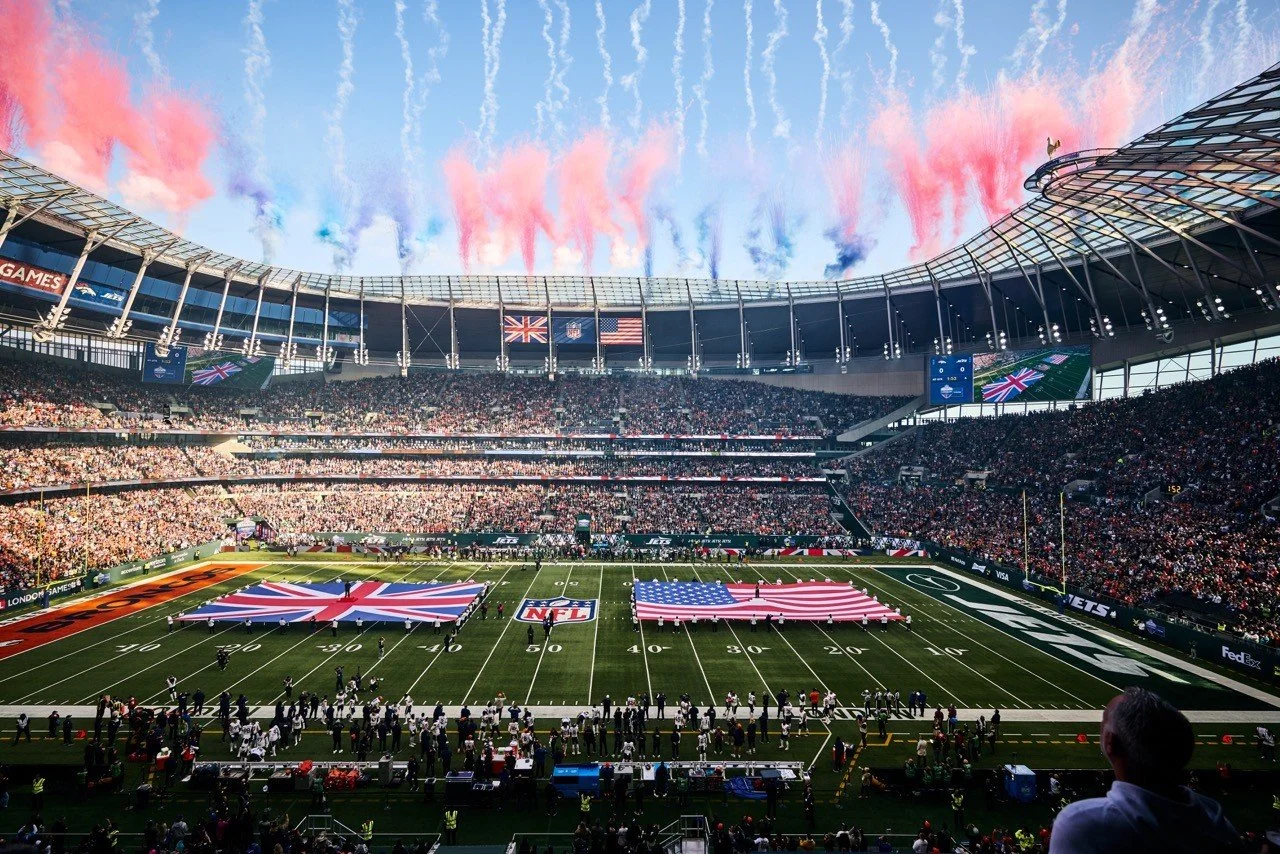
Image: Sam Allard
MT: And lastly, what's your advice to anyone entering photo marathon?
SA: Enjoy it, don't overthink it. Just enjoy taking photos. It's a wonderful thing to do, and as with many things, just go out and do it.
MT: Great, great advice. Thank you, Sam.
SA: Pleasure.
Sam’s portfolio can be found here: Sam Allard • Photographer • Fisher Studios